
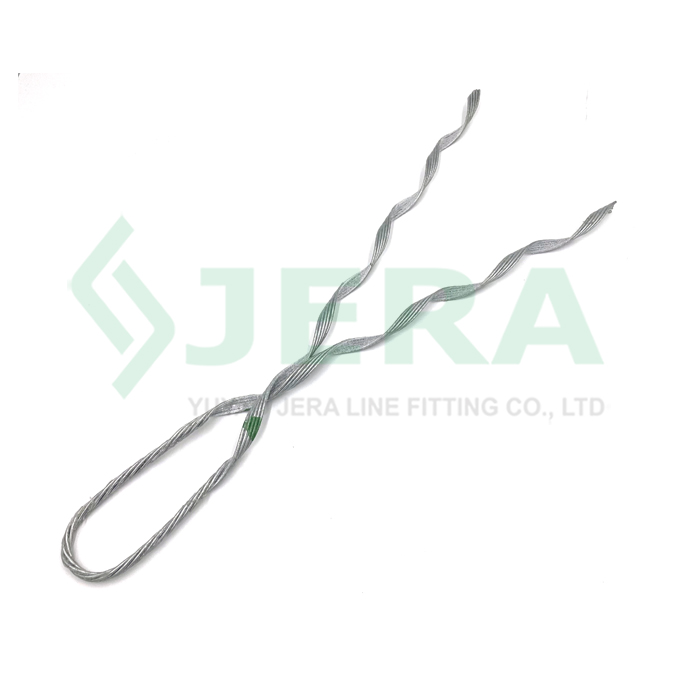
 Environmental adaptability assessment is of crucial importance. In the northwest region where the temperature difference exceeds 70 degrees Celsius, the wire clamp structure of guy wire dead end should be able to compensate for the 3-millimeter expansion and contraction caused by temperature changes from -30℃ to 40℃. The case of the Qinghai-Xizang power Grid project shows that after adopting the terminal head with elastic elements, the stress fluctuation amplitude of the tie wire was reduced by 60%, and the tilt of the utility pole in the frost heave soil was always controlled within a safe range of 0.5 degrees. This technology increased the line availability rate from 99.2% to 99.9%.
The full life cycle cost accounting shows that although the purchase cost of high-quality guy wire dead end is 20% higher than that of ordinary products, its operation and maintenance cost over 30 years can be saved by 55%. According to the statistics of the American Public Utilities Association, investing in terminal heads that comply with the IEEE 524 standard can reduce the fault repair time from 48 hours to 8 hours, and decrease the loss of a single power outage by approximately 120,000 US dollars. This strategy is like equipping the infrastructure with long-term health insurance, increasing the overall return on investment of the project by 18 percentage points.
The standardization of the installation process directly affects the safety performance. When the tightening torque of guy wire dead end is controlled at 110±5 N · m using a torque wrench, its anti-slip performance is improved by 30% compared with manual installation. Intelligent construction records show that through the assistance of drone inspection for installation positioning, the installation qualification rate of the 200-pole tower project can be raised from 85% to 98%, and the construction period can be shortened by 20%. This precision control is like implanting a dynamic balance algorithm into the guy wire system.
Environmental adaptability assessment is of crucial importance. In the northwest region where the temperature difference exceeds 70 degrees Celsius, the wire clamp structure of guy wire dead end should be able to compensate for the 3-millimeter expansion and contraction caused by temperature changes from -30℃ to 40℃. The case of the Qinghai-Xizang power Grid project shows that after adopting the terminal head with elastic elements, the stress fluctuation amplitude of the tie wire was reduced by 60%, and the tilt of the utility pole in the frost heave soil was always controlled within a safe range of 0.5 degrees. This technology increased the line availability rate from 99.2% to 99.9%.
The full life cycle cost accounting shows that although the purchase cost of high-quality guy wire dead end is 20% higher than that of ordinary products, its operation and maintenance cost over 30 years can be saved by 55%. According to the statistics of the American Public Utilities Association, investing in terminal heads that comply with the IEEE 524 standard can reduce the fault repair time from 48 hours to 8 hours, and decrease the loss of a single power outage by approximately 120,000 US dollars. This strategy is like equipping the infrastructure with long-term health insurance, increasing the overall return on investment of the project by 18 percentage points.
The standardization of the installation process directly affects the safety performance. When the tightening torque of guy wire dead end is controlled at 110±5 N · m using a torque wrench, its anti-slip performance is improved by 30% compared with manual installation. Intelligent construction records show that through the assistance of drone inspection for installation positioning, the installation qualification rate of the 200-pole tower project can be raised from 85% to 98%, and the construction period can be shortened by 20%. This precision control is like implanting a dynamic balance algorithm into the guy wire system.
Design Log · Field Notes
How to pick the best guy wire dead end for utility pole projects?
When choosing the optimal guy wire dead end for the utility pole project, it is necessary to first analyze the matching degree between its mechanical performance and the designed load. The breaking strength of a high-quality Guy Wire dead end should be at least 1.5 times the rated tensile strength of the guy wire, that is, the safety factor reaches 150%. According to the ANSI/TIA-222 standard, in a Class III wind zone with wind speeds reaching 145 kilometers per hour, the terminal heads must be capable of withstanding continuous tension exceeding 20 kilonewtons. For instance, during the hurricane that hit Florida in 2023, the collapse rate of utility poles using compliant products was 75% lower than that using non-standard products, effectively protecting the distribution network worth millions of dollars.
In terms of material durability selection, the hot-dip galvanized steel guy wire dead end can have a service life of up to 30 years in saline-alkali areas. Its zinc coating thickness needs to be greater than 86 microns to ensure a once-in-a-century protective effect under the condition of an average annual corrosion rate of 0.8 microns. The comparative data shows that the terminal head conforming to ASTM A123 standard has a lifespan 2.3 times that of ordinary products in a humid environment. For example, in the power grid renovation project of Zhoushan Archipelago in China, after adopting high-specification galvanized coating, the replacement cycle was extended from 10 years to 25 years, and the maintenance cost was reduced by 40%.
Environmental adaptability assessment is of crucial importance. In the northwest region where the temperature difference exceeds 70 degrees Celsius, the wire clamp structure of guy wire dead end should be able to compensate for the 3-millimeter expansion and contraction caused by temperature changes from -30℃ to 40℃. The case of the Qinghai-Xizang power Grid project shows that after adopting the terminal head with elastic elements, the stress fluctuation amplitude of the tie wire was reduced by 60%, and the tilt of the utility pole in the frost heave soil was always controlled within a safe range of 0.5 degrees. This technology increased the line availability rate from 99.2% to 99.9%.
The full life cycle cost accounting shows that although the purchase cost of high-quality guy wire dead end is 20% higher than that of ordinary products, its operation and maintenance cost over 30 years can be saved by 55%. According to the statistics of the American Public Utilities Association, investing in terminal heads that comply with the IEEE 524 standard can reduce the fault repair time from 48 hours to 8 hours, and decrease the loss of a single power outage by approximately 120,000 US dollars. This strategy is like equipping the infrastructure with long-term health insurance, increasing the overall return on investment of the project by 18 percentage points.
The standardization of the installation process directly affects the safety performance. When the tightening torque of guy wire dead end is controlled at 110±5 N · m using a torque wrench, its anti-slip performance is improved by 30% compared with manual installation. Intelligent construction records show that through the assistance of drone inspection for installation positioning, the installation qualification rate of the 200-pole tower project can be raised from 85% to 98%, and the construction period can be shortened by 20%. This precision control is like implanting a dynamic balance algorithm into the guy wire system.
Environmental adaptability assessment is of crucial importance. In the northwest region where the temperature difference exceeds 70 degrees Celsius, the wire clamp structure of guy wire dead end should be able to compensate for the 3-millimeter expansion and contraction caused by temperature changes from -30℃ to 40℃. The case of the Qinghai-Xizang power Grid project shows that after adopting the terminal head with elastic elements, the stress fluctuation amplitude of the tie wire was reduced by 60%, and the tilt of the utility pole in the frost heave soil was always controlled within a safe range of 0.5 degrees. This technology increased the line availability rate from 99.2% to 99.9%.
The full life cycle cost accounting shows that although the purchase cost of high-quality guy wire dead end is 20% higher than that of ordinary products, its operation and maintenance cost over 30 years can be saved by 55%. According to the statistics of the American Public Utilities Association, investing in terminal heads that comply with the IEEE 524 standard can reduce the fault repair time from 48 hours to 8 hours, and decrease the loss of a single power outage by approximately 120,000 US dollars. This strategy is like equipping the infrastructure with long-term health insurance, increasing the overall return on investment of the project by 18 percentage points.
The standardization of the installation process directly affects the safety performance. When the tightening torque of guy wire dead end is controlled at 110±5 N · m using a torque wrench, its anti-slip performance is improved by 30% compared with manual installation. Intelligent construction records show that through the assistance of drone inspection for installation positioning, the installation qualification rate of the 200-pole tower project can be raised from 85% to 98%, and the construction period can be shortened by 20%. This precision control is like implanting a dynamic balance algorithm into the guy wire system.