
MDF from 2 mm to 30 mm: Picking a Board by Job
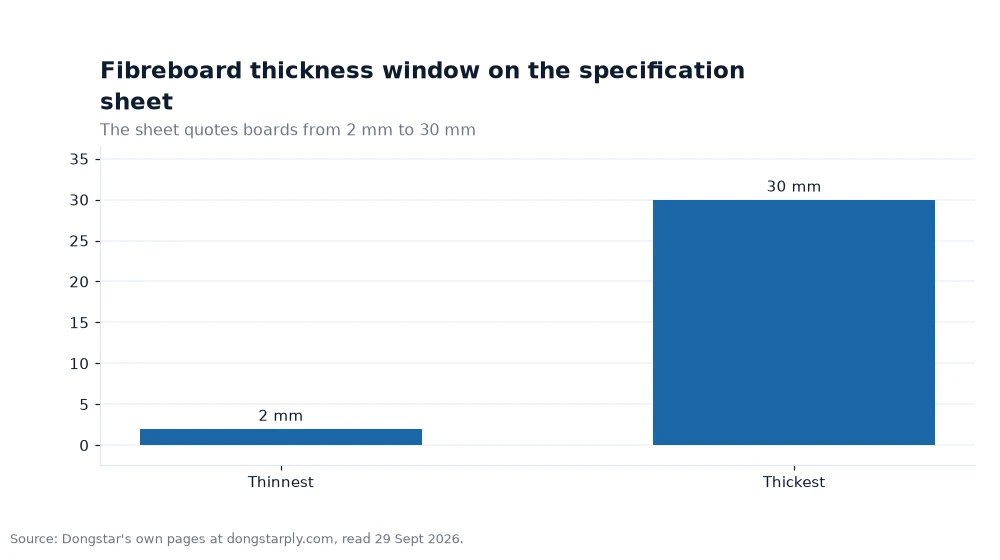
The published thickness window for the fibreboard range runs from 2 mm to 30 mm, with printed steps at the listed steps 2.7, 3, 6, 9, 12, 15 and 18 mm. Tolerance is quoted between ±0.2 mm and ±0.5 mm, and one of the two formats — 2100 × 2500 mm — is offered only on boards of 9 mm or less. Read those three lines together and a long catalogue becomes a short list of jobs.

Key takeaways
- The window opens at 2 mm and closes at 30 mm, with 2.7, 3, 6, 9, 12, 15 and 18 mm printed as steps.
- Tolerance is a band from ±0.2 mm to ±0.5 mm, and it decides joint width and stack height long before it decides price.
- The 2100 × 2500 mm format is quoted for 9 mm and thinner boards; 1220 × 2440 mm covers the rest of the range.
- Raw MDF, MHR MDF, FR MDF and HDF are four different answers to four different jobs, not four names for one board.
Read the window before the job list
A range described as 2 mm to 30 mm sounds like a catalogue flourish until you look at how it is printed. The sheet lists discrete steps first — 2.7, 3, 6, 9, 12, 15 and 18 mm — and then adds that other thicknesses are available on request. What sits behind that wording is a mill separating the sizes it keeps available from the ones it presses to order. A 20 mm request is a scheduling question before it is a pricing question, and asking it early costs nothing.
Tolerance deserves the same attention, because a band of ±0.2 mm to ±0.5 mm is not one number. Laminate two 18 mm boards into a 36 mm top and the finished thickness can arrive at 36.4 mm or 35.6 mm before glue lines are counted (example arithmetic). Drawings built around a single exact figure are the usual source of on-site shimming, and a practical reading of the Medium Density Fibreboard sheet starts by separating the nominal size from the band it is allowed to land in.
Thin end: 2.7 mm to 6 mm
Boards of 6 mm and under are skin and backing material. They turn up as drawer bottoms, cabinet backs, door skins laminated over a frame, and as curved panels bent over a former — a 3 mm sheet bends around a radius that a 12 mm sheet would split across. This is also where the larger format lives, since 2100 × 2500 mm is quoted for thicknesses of 9 mm or less, which lets a single-piece back or lining be cut without a joint down the middle.
Thin boards are unforgiving about support. Six millimetres over a frame with uprights at 600 mm centres will sag; the same board on a 300 mm grid stays flat for years. When an order sits at this end of the range, the framing plan is part of the specification, and the person signing off the panel should also be the one signing off the centres. Fixing matters as well, because a 3 mm sheet wants a groove, a batten or an adhesive line rather than a screw driven through its thickness.
Middle of the range: 9, 12 and 15 mm
Nine, twelve and fifteen millimetres carry most interior work — wall panels, partitions, acoustic linings, false ceilings, moldings and the flat leaves of doors. The mill's own application list places this board in furniture, interior decoration and construction, and these three thicknesses are where that reading holds up. Nine millimetres over a batten grid makes a wall lining; fifteen millimetres makes a partition that accepts a screw without a backing plate hidden behind it.
Surface choices become visible at this size too. Sheets arrive plain, or faced on one or both sides with melamine paper, HPL, PVC or leather. The listed treatments are matt, textured, glossy, embossed and magic, and the colour offer runs from solid tones through wood grains to fabric and marble effects. Because a faced board is bought for what it shows, the thickness decision here is mostly about span, rigidity and edge treatment rather than appearance.
18 mm and up: carcasses and working surfaces
Eighteen millimetres is the shelf and carcass size for a reason: it is roughly the thinnest sheet that holds a domestic shelf span and takes a hinge screw without a doubler behind it. The furniture list — cabinets, shelves and tables — is written around that figure. Above it the window continues to 30 mm, where boards are chosen for an edge that will be seen: working tops, reception counters, shopfitting and profile-cut moldings.
Going up in thickness changes the material arithmetic more than the price list. A 25 mm board carries about 39% more material than an 18 mm board of the same footprint (example), which is why working tops are often built as an 18 mm panel with a solid edge strip rather than cut from a thick sheet. Panel counts fall faster than cost when thickness rises, so a cutting plan drawn for 18 mm usually has to be redrawn rather than scaled.
What sits under the face: raw, MHR MDF, FR MDF, HDF
Thickness is the decision a client can see. The base board is the one they cannot, and it decides how the panel behaves in the room it finishes up in. Four are listed: an untinted raw core, the green MHR MDF, the red FR MDF and the black HDF. A kitchen carcass in a steamy apartment wants the green core. A corridor lining specified against an interior fire brief wants the red one. A floor, a classroom table or a heavy-traffic surface wants the black HDF.
The colours are not branding. Once a melamine face is pressed on, a raw core and a moisture-resistant core look the same from the edge, so MHR MDF and FR MDF arrive colour-coded rather than as anonymous sheets. If an order mixes base boards under a single decorative face, the packing list has to name which is which — otherwise the difference is discovered by the fitter on site rather than by the buyer at the desk.
| Job in the workshop | Listed thickness | Format note |
|---|---|---|
| Cabinet backs, drawer bottoms, door skins | 2.7, 3 and 6 mm | 2100 × 2500 mm available at 9 mm and below |
| Wall linings, partitions, ceiling panels | 9, 12 and 15 mm | 1220 × 2440 mm as the everyday footprint |
| Cabinet carcasses and shelving | 18 mm | A ±0.5 mm band drives stack height over a full pallet |
| Working tops, counters, shopfitting | 18 mm and thicker, up to 30 mm | Edge profile and face material decide the grade |
| Humid or fire-briefed interior linings | Any listed step | Choose MHR MDF or FR MDF as the base board |
Worked example: two formats, one cutting list
A shop has to line 240 m² of interior wall with 6 mm board. In the 1220 × 2440 mm format the sheet is 1.22 m × 2.44 m = 2.9768 m², or 2.98 m² once rounded. Dividing the wall area gives 240 ÷ 2.98 = 80.5, so the order needs 81 sheets (example). Run the same job in the 2100 × 2500 mm format, which the range quotes at 9 mm and below: 2.1 m × 2.5 m = 5.25 m², and 240 ÷ 5.25 = 45.7, so 46 sheets (example).
The second route uses 35 fewer sheets for the same covered area, 46 against 81, and it removes a similar number of joints from the finished wall. That is the whole argument for the large format and also its limit, since the format is not offered above 9 mm and cannot rescue an 18 mm job. Neither count includes cutting waste, and thickness allowance does not vanish in a big stack: 46 sheets at the loose end of a ±0.5 mm band add 23 mm of height on their own (example).
Frequently asked questions
Does the 2 mm to 30 mm window mean every thickness is a stock item?
No. The sheet prints 2.7, 3, 6, 9, 12, 15 and 18 mm as steps and adds that other thicknesses are available on request. Anything sitting between those lines is a production question, so it belongs in the enquiry rather than in a fixed drawing.
Which format suits a large backing panel?
The 2100 × 2500 mm format is quoted for boards of 9 mm and below, which makes it a natural fit for backings and skins. Above that thickness the choice is 1220 × 2440 mm. Compare the two on area — 5.25 m² against 2.98 m² — before assuming the bigger sheet is the cheaper route once waste is counted.
What does the tolerance figure actually change?
Joint width and stack height. Across a 46-sheet stack the ±0.5 mm end of the band adds about 23 mm of height by itself, and a laminated 36 mm top can arrive at 35.6 mm or 36.4 mm depending on which end of the band the boards come from.
Match the board to the drawing, then to the mill
The quickest way to narrow a wide range is to write down what the panel has to do: span a shelf, line a wall, take a hinge, face a counter. Most of those answers sit inside the full panel range the group publishes, and where a job needs a decorative face over a stable core, the melamine-faced sheets are worth comparing side by side with the plain board before a format is fixed. Thickness is the first line of the spec sheet, not the last one.
Thickness steps, tolerances, formats and base board descriptions in this article are lifted from the manufacturer's site, read 29 Sept 2026, and taken for this guide, for the numbers in this article[1].